

To win more chess games, focus on developing your pieces early. Move them from their starting positions to active squares. Control the center by occupying key squares like e4 and d4. Protect your king by castling, which also connects your rooks. Understand the value of each piece; for example, pawns are worth one point and queens nine. Create a solid opening strategy by developing knights and bishops early, and you’ll see improvement. There’s more to explore about strategy.
Understanding the Importance of Piece Development
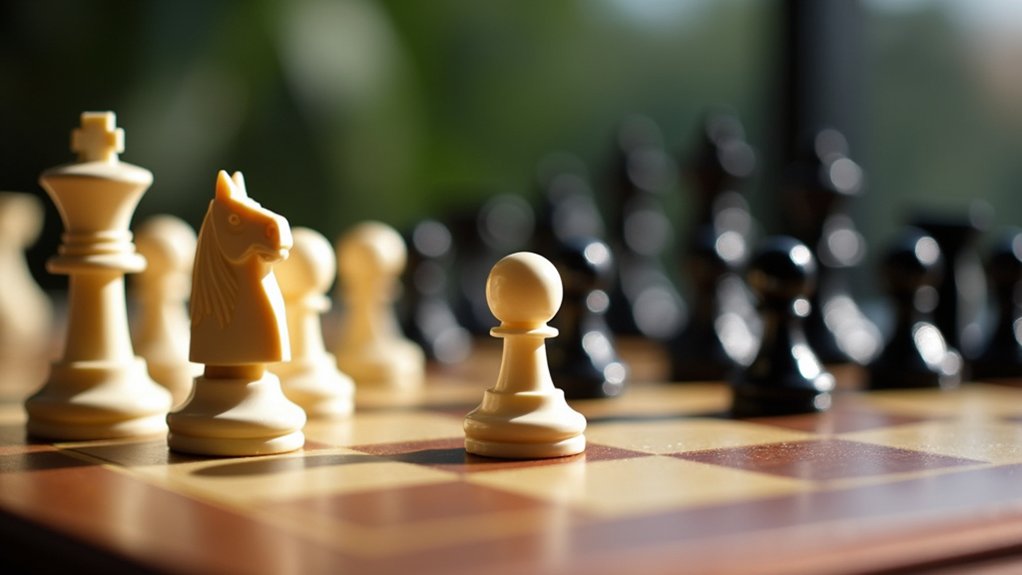
Piece development is a key concept in chess that every beginner should understand. It refers to moving your pieces from their starting positions to more active squares. Good piece coordination means your pieces work well together, supporting each other.
Focusing on early mobility is vital. The sooner you develop your knights and bishops, the better your chances of controlling the game. Additionally, proper piece development is crucial for establishing a solid foundation for the middlegame.
Avoid moving the same piece multiple times in the opening. Instead, aim to connect your rooks and control key squares. This strategy leads to a stronger position, enabling you to respond effectively to your opponent’s moves and set up for future attacks.
Controlling the Center of the Board
Controlling the center of the board is essential for gaining an advantage in chess. Center control means occupying key squares in the middle of the board, specifically e4, e5, d4, and d5. By doing this, you can move your pieces more freely and restrict your opponent’s options.
To achieve center control, develop your pawns and pieces toward these central squares. For example, moving your pawns to e4 or d4 helps you dominate the center.
Position your knights and bishops to support your pawns, creating a strong foothold. This strategy enables you to launch attacks and defend effectively throughout the game. Additionally, maintaining king safety while controlling the center is crucial to avoid vulnerabilities in your position.
Protecting Your King: Castling and Other Techniques
Once you’ve established control of the center, it’s time to focus on protecting your king. One effective method is using castling techniques. Castling is a special move that allows you to move your king to safety while also developing a rook.
To castle, you need to guarantee that neither the king nor the rook has moved before, and there are no pieces between them. You can castle kingside or queenside, depending on your strategy. Additionally, always consider placing pawns and pieces around your king to enhance king safety. This creates a solid defense against potential attacks and keeps your position stable. Understanding the specific rules governing castling is essential for executing this important maneuver correctly.
The Value of Each Piece
In chess, each piece has a specific value that helps you understand its importance during the game. The pawn value is the lowest, usually worth one point, but they can promote to stronger pieces.
Rooks are valued at five points, while knights and bishops are worth three. The queen is the most valuable piece at nine points, and the king is invaluable, as losing it means losing the game.
Piece mobility, or how far each piece can move, also matters. A piece with greater mobility can control more squares, making it more effective. Additionally, these standard point values serve as a guideline for making strategic trades during the game.
Understanding these values will improve your strategy.
Creating a Solid Opening Strategy
A solid opening strategy is essential for setting the tone of your chess game. Start by following key opening principles. Control the center of the board with your first moves; central squares allow your pieces greater mobility.
Develop your knights and bishops early, rather than moving the same piece multiple times. This helps you prepare for later phases of the game. It’s also important to guarantee your king’s safety, often by castling.
Avoid bringing your queen out too soon, as it can become a target. By adhering to these strategies, you’ll create a strong foundation for your chess success. Additionally, focusing on fundamental openings can greatly enhance your understanding of strategic play.
Recognizing and Exploiting Weaknesses
After establishing a solid opening strategy, the next step is recognizing and exploiting weaknesses in your opponent’s position.
Look for exposed pieces, such as unprotected pawns or vulnerable bishops. These are your chances for capitalizing errors.
When you spot a weakness, plan your moves to attack it directly. For instance, if a pawn is isolated, consider putting pressure on it with your pieces.
Exposing vulnerabilities can lead to material gain or a better position.
Always be alert for opportunities to take advantage of your opponent’s mistakes. This awareness can greatly improve your chances of winning. Additionally, understanding how to recognize common blunders can help you capitalize on your opponent’s errors more effectively.
The Importance of Pawn Structure
Pawn structure plays an essential role in chess strategy. Your pawn formation affects how pieces move and control the board. Strong pawn placement supports your pieces, while weak formations can lead to vulnerabilities.
Understanding pawn tension is vital; it refers to the pressure pawns exert on each other. You can create tension to challenge your opponent’s pawns, forcing them to make uncomfortable decisions.
Always look for ways to improve your pawn structure. Aim for connected pawns, avoid doubled pawns, and maintain a solid center.
A strong pawn structure gives you a solid foundation for launching attacks and defending your position effectively. Additionally, pawns can be promoted to stronger pieces when they reach the opposite end of the board, significantly impacting your overall strategy.
Planning Your Endgame Strategy
Planning your endgame strategy is essential for success in chess. In this phase, you focus on your remaining pieces and their positioning. You should use effective endgame techniques, like promoting pawns and controlling key squares.
Aim to simplify the game by exchanging pieces when you have a material advantage. When it’s time for your final moves, think carefully about how each piece can work together.
Consider your opponent’s responses, and always keep an eye on checkmating patterns. By practicing these strategies, you’ll improve your chances of winning in the endgame, turning small advantages into victory. Mastering this phase requires understanding fundamental principles, such as opposition, to gain a strategic edge.
Practicing Tactics and Combinations
To improve your chess game, practicing tactics and combinations is essential. Tactics training helps you recognize patterns and opportunities during a match. Focus on solving combination puzzles, which are specific sequences of moves that lead to a winning advantage.
Start with simple puzzles and gradually move to more complex ones. Set aside time each day for this practice. Use online resources or chess books to find these puzzles.
As you train, pay attention to themes like forks, pins, and discovered attacks. By mastering these tactics, you’ll enhance your gameplay and increase your chances of winning against opponents.
FAQs
What Is the Best Way to Learn Chess Openings?
To learn chess openings, start by understanding opening principles. These are rules like controlling the center, developing pieces, and ensuring king safety. Practice these ideas in your games.
Next, study common opening traps. These are clever tactics that can catch your opponent off guard. Familiarize yourself with examples, and try them out in practice games.
Finally, review your games to see what worked and what didn’t. This helps you improve your opening skills.
How Can I Improve My Chess Concentration During Games?
To improve your chess concentration during games, try mindfulness techniques. This means focusing on the present moment, without distractions. Take deep breaths before each move to calm your mind.
You can also use focus exercises. For example, practice staring at a chessboard for a few minutes, noticing every piece’s position. This helps sharpen your attention.
Regularly practicing these methods will enhance your concentration, allowing you to make better decisions in your games.
What Resources Are Available for Studying Chess Tactics?
To study chess tactics effectively, you can use tactics books and online puzzles. Tactics books explain different strategies and provide exercises for practice. Look for beginner-friendly options.
Online puzzles are interactive and allow you to solve real-time problems. Websites and apps offer daily puzzles that challenge your skills.
These resources help you recognize patterns and improve your tactical thinking. Regular practice with both will sharpen your abilities and enhance your overall game.
How Do I Handle Time Pressure in Chess Games?
When you face time pressure in a chess game, prioritize time management. Break down your thinking into quick evaluations of your options.
Focus on your opponent’s threats and your best responses. Use psychological tactics, like making unexpected moves, to create confusion.
Practice playing with a timer to get used to quick decisions. Stay calm, breathe, and remember that every second counts.
This will help you make better choices under pressure.
What Are Common Chess Mistakes to Avoid as a Beginner?
As a beginner, avoid common mistakes like overextending pieces and ignoring development.
Overextending means moving your pieces too far forward without support. This can leave them vulnerable.
Focus on developing your pieces, which means moving them from their starting positions to more active squares where they control the board.
Prioritize controlling the center and connecting your rooks. These steps will help you play stronger games and reduce errors.
Final Thoughts
To sum up, using these basic chess strategies can help you improve your game. Focus on developing your pieces, controlling the center, and protecting your king. Remember the value of each piece and pay attention to your pawn structure. Plan your moves and practice tactics regularly. By applying these techniques, you’ll recognize weaknesses in your opponent’s position and create a solid opening strategy. Keep practicing, and you’ll start winning more games.


