

To play chess effectively, you need to know some key terms. Start with the board: it has 64 squares in an 8×8 grid. Learn the basic moves for each piece. Pawns move forward and capture diagonally. Special moves like castling (moving the king and rook) and en passant (capturing a pawn in a unique way) are important. The game’s goal is to checkmate the opponent’s king, meaning it is trapped. There’s more to discover about strategies and notation as you progress.
Understanding the Board and Pieces
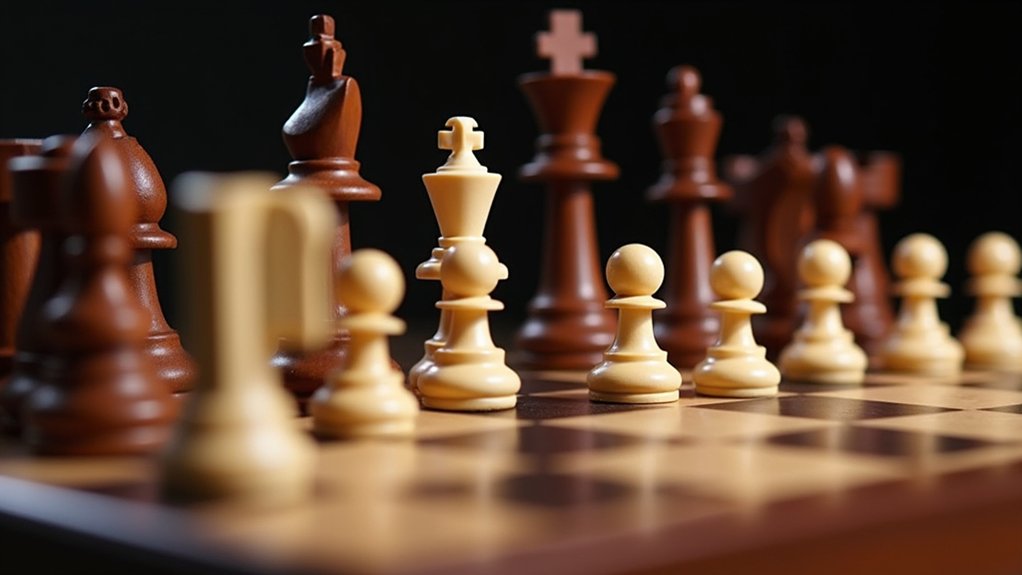
Chess is played on a square board divided into 64 smaller squares, arranged in an 8×8 grid. Each square alternates in color, usually light and dark.
The board layout is important for understanding the game. Each player starts with 16 pieces, including pawns, knights, bishops, rooks, a queen, and a king.
Piece value helps you evaluate the strength of each piece. Pawns are worth 1 point, knights and bishops are worth 3 points, rooks are worth 5 points, and queens are worth 9 points. Understanding piece value is crucial as it can influence your trading decisions and overall strategy.
Knowing these values can guide your strategy and help you make informed decisions during the game.
Basic Moves and Captures
Knowing the layout of the board helps you understand how the pieces move. Each piece has unique movement rules. For example, pawns move forward one square but capture diagonally. When a pawn reaches the opponent’s back row, it can undergo pawn promotion, turning into a more powerful piece like a queen. Additionally, it’s important to remember that pawns can only capture diagonally forward, which is a fundamental rule in chess.
Knights move in an L-shape, jumping over other pieces. They can go two squares in one direction and then one square perpendicular. This unique knight movement allows them to navigate around obstacles effectively.
Understanding these basic moves and captures is essential for developing your chess skills.
Special Moves: Castling and En Passant
Two special moves in chess can greatly influence the game: castling and en passant.
Castling is a unique move involving the king and a rook. To follow the castling rules, the king moves two squares towards the rook, and the rook jumps over the king to the next square. This move can only happen if neither piece has moved, there are no pieces between them, and the king isn’t in check, as the official chess rules state that castling is prohibited when the king is in check.
En passant mechanics involve capturing a pawn that moves two squares forward from its starting position. You can capture it as if it moved only one square, but you must do this immediately after the move.
The Objective: Check, Checkmate, and Stalemate
In a game of chess, the main goal is to checkmate your opponent’s king. Check means the king is under attack and must move to safety. In check scenarios, you need to either move the king or block the attack.
Checkmate occurs when the king can’t escape capture, ending the game.
Sometimes, a stalemate happens when a player has no legal moves left but isn’t in check. This results in a draw. A stalemate can be particularly frustrating as it often feels like a lost opportunity, making it essential to understand the rules of draws in chess.
Stalemate examples include when the king is cornered but not attacked.
Understanding these objectives will help you play strategically and improve your chances of winning.
Opening Principles and Strategies
When you start a chess game, having a solid opening strategy is essential for setting yourself up for success. Focus on opening development, which means moving your pieces out efficiently. Aim to control the center of the board with your pawns and pieces, as this gives you more options.
Pay attention to your pawn structure, which is how your pawns are arranged. A strong pawn structure supports your pieces and protects your king.
Avoid moving the same piece multiple times in the opening. Instead, develop all your pieces evenly, ensuring they work together for a strong position. Understanding fundamental principles of chess openings can greatly enhance your strategic approach.
Middle Game Tactics
As you shift from the opening to the middle game, you’ll need to focus on tactics that can help you gain an advantage. Here, tactical themes like forks, pins, and skewers become important. A fork attacks two pieces at once, while a pin restricts a piece’s movement.
You should also pay attention to piece coordination. This means positioning your pieces to work together effectively. When your pieces support each other, they can create stronger attacks and defend against your opponent’s threats. Knights can be particularly effective in this phase, as their ability to create knight forks can catch your opponent off guard.
Always look for opportunities to improve your tactical play, as this can greatly influence the outcome of the game.
Endgame Fundamentals
Understanding the endgame is essential because it often determines the outcome of a chess match. In this phase, fewer pieces remain on the board, and your strategy shifts.
One key concept is king opposition. This means placing your king directly opposite your opponent’s king, which helps control the board.
Another important idea is pawn promotion. When a pawn reaches the opposite side of the board, it can become a more powerful piece, like a queen.
Mastering these fundamentals can give you the edge you need. Focus on positioning your king effectively and advancing your pawns wisely for success. Additionally, understanding theoretical positions can further enhance your endgame strategy.
Common Chess Notation
After mastering endgame fundamentals, it’s important to learn how to record and read chess moves using common chess notation. The most widely used is algebraic notation, where each piece has a letter abbreviation: K for king, Q for queen, R for rook, B for bishop, and N for knight.
Descriptive notation uses piece names and board coordinates, but it’s less common now. You’ll encounter notation symbols, like “x” for capture and “+” for check. Understanding the movement capabilities of each piece is crucial for effective notation.
Move notation helps with game recording, ensuring notation clarity. Understand these terms, and you’ll communicate your chess games effectively, making it easier to study and improve.
Essential Chess Strategies
To win at chess, you need effective strategies that guide your moves and decisions. Focus on positional play, which means controlling key squares and improving your pieces’ positions. This allows you to create strong formations and limit your opponent’s options.
Develop tactical awareness by looking for opportunities to use tactics like forks, pins, and skewers. These can help you gain material advantage or checkmate your opponent.
Always think a few moves ahead, considering both your strategy and your opponent’s potential responses.
Resources for Further Learning
When you want to improve your chess skills, using various resources can make a big difference. Start with online resources, like instructional websites and video tutorials. These platforms often offer lessons, puzzles, and forums where you can ask questions.
Next, consider chess books. Look for beginner guides that explain strategies and tactics clearly. Many books include diagrams to help you visualize moves and formations.
Additionally, joining a local chess club can provide hands-on experience and support from other players.
Combining these resources will enhance your understanding and enjoyment of the game, helping you become a better chess player over time.
FAQs
What Is the Origin of Chess and Its Historical Significance?
Chess originated in India around the 6th century. It evolved through Persia and the Islamic world before reaching Europe.
This game reflects strategic thinking and planning, influencing cultures worldwide. Its evolution shows how games can adapt over time, reflecting social changes.
Chess has a significant cultural impact, promoting critical thinking skills and problem-solving. Understanding its origins helps you appreciate its role in history and its lasting significance in today’s society.
How Do Time Controls Work in Chess Tournaments?
In chess tournaments, time controls are rules that limit how long each player can think. You’ll find different tournament formats, like classical, rapid, and blitz, each with its own time limits.
Time management is essential, as it helps you make decisions quickly. For example, in a blitz game, you might only have three minutes for the entire match.
Understanding these rules helps you play more effectively and avoid losing on time.
What Is the Role of Chess Etiquette During Matches?
During matches, chess etiquette is essential. You should always show respect to your opponent, which means not talking while they’re thinking.
Follow sportsmanship principles, like shaking hands before and after the game.
If you make a mistake, you can acknowledge it gracefully without blaming anyone else.
Keep the environment quiet and focused, allowing both players to concentrate.
Good chess manners create a positive atmosphere and help everyone enjoy the game more.
How Can I Improve My Chess Skills Outside of Playing?
To improve your chess skills outside of playing, focus on solving chess puzzles. These are problems where you find the best move or sequence of moves. They help sharpen your tactical skills.
Also, read strategy books. These books explain various strategies and concepts in chess. They provide insights into planning and decision-making during games.
What Are Some Common Chess Myths to Avoid?
When playing chess, it’s important to avoid common myths. One misconception is that chess superstitions, like wearing lucky items, can influence the game. This isn’t true; skills matter more.
Another beginner misconception is thinking you can only win by capturing the opponent’s king. Actually, checkmate ends the game, regardless of other pieces.
Focus on developing your strategy and understanding the game better instead of relying on these myths for success.
Final Thoughts
Now that you know key chess terms and concepts, you’re ready to improve your game. Remember the board setup, piece movements, and special rules like castling. Practice strategies for openings and endgames. Use chess notation to track your games. Don’t forget to explore resources for further learning, like books and online tutorials. With practice and patience, you’ll become a better player. Keep playing, keep learning, and enjoy the game of chess.


