

Yes, a pawn can take a queen in chess if the queen is on an adjacent diagonal square. Pawns move forward one square but capture diagonally. This means if an opponent’s queen is positioned diagonally in front of a pawn, it can capture the queen on the next turn. Remember, capturing is only allowed if the queen is within range. Understanding how pawns interact with other pieces can help improve your game strategy.
Understanding Pawn Movement

When you play chess, understanding how a pawn moves is essential. A pawn moves forward one square, but it captures diagonally. This means you can only take an opponent’s piece if it’s one square away to the left or right.
Utilizing pawn movement strategies helps control the board. For instance, advancing two squares on its first move can surprise your opponent. Special moves like en passant can also change the tide of the game if executed correctly.
Pawn advancement tactics involve creating chains or forming a strong front line. By supporting your pawns with other pieces, you enhance their power.
The Role of the Queen in Chess
The queen is the most powerful piece on the chessboard. She can move any number of squares in any direction—horizontally, vertically, or diagonally. This queen’s power makes her vital in both offense and defense.
You should use her to control key areas of the board, putting pressure on your opponent. Her strategic importance lies in her ability to threaten multiple pieces at once, making her a valuable asset during the game. Additionally, understanding common tactics involving the queen can enhance your overall strategy and effectiveness in play.
Protecting your queen is essential, as losing her can greatly weaken your position. Always consider her moves carefully to maximize your chances of winning.
Basic Rules for Capturing Pieces

Capturing pieces in chess follows specific rules that every player should know. Each piece has unique capturing tactics. For example, a rook moves in straight lines, capturing any piece in its path. A bishop moves diagonally, while the knight jumps to capture pieces in an L-shape.
Understanding piece interactions is essential. You can only capture an opponent’s piece by landing on its square. Remember, you can’t capture your own pieces. Additionally, pawns have unique capturing rules, as they can only capture diagonally forward direction and never backwards.
After a capture, the opponent’s piece is removed from the board. Familiarize yourself with these rules to enhance your game strategy and improve your overall performance in chess.
Can a Pawn Capture Any Piece?
How does a pawn capture other pieces on the chessboard? A pawn captures by moving diagonally forward, one square at a time. This means you can take an opponent’s piece if it’s positioned at an adjacent diagonal square.
In terms of pawn interactions, you must remember that a pawn can only capture pieces like knights, bishops, rooks, and queens, but not other pawns in the same way.
The piece hierarchy in chess shows that pawns are the lowest, but they can still capture higher-ranked pieces. Additionally, it’s important to note that a pawn can advance two squares on its first move, which can impact its ability to capture the two-square rule in certain situations.
Understanding these rules helps you make strategic decisions during your games.
Specifics of Pawn Capture
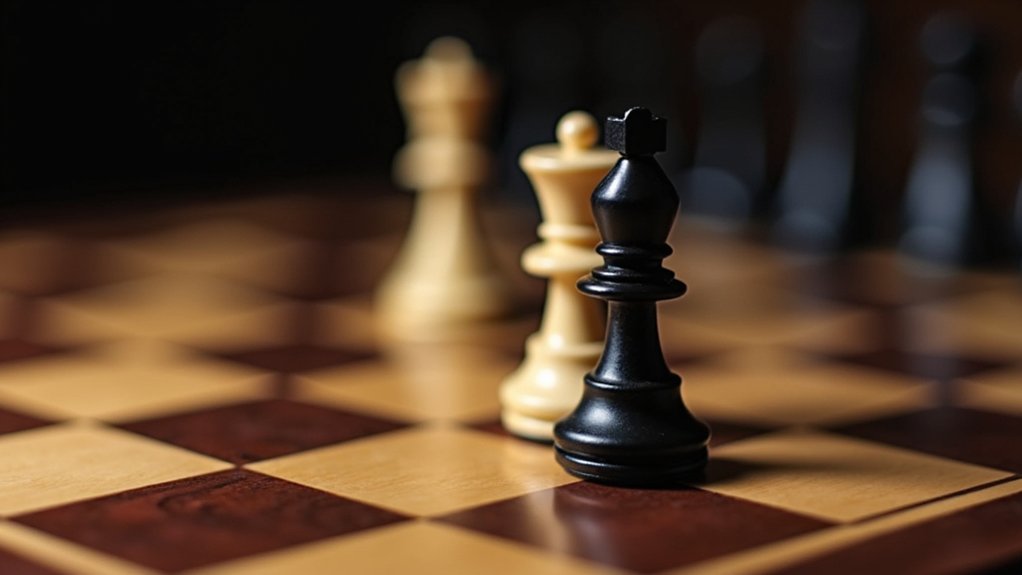
When you want to capture an opponent’s piece with a pawn, you need to pay attention to its movement. Pawns move forward one square but capture diagonally. This means you can only take an opponent’s piece if it’s in a diagonal square directly in front of your pawn.
Understanding pawn capture mechanics is vital. When deciding to use your pawn, think about pawn movement strategies. Position your pawn to threaten enemy pieces and control important squares. Additionally, remember that pawns can only capture pieces when moving diagonally to the left or right, highlighting their unique movement rules.
Always be aware of your opponent’s potential responses. By mastering these basics, you’ll improve your ability to use pawns effectively in your chess games.
The Concept of En Passant
En passant is a special pawn capture that can catch many players off guard. This move occurs when a pawn advances two squares from its starting position, landing beside an opposing pawn. You can capture it as if it moved only one square forward.
To use the en passant strategy, you must act immediately on your next turn. If you wait, you lose the chance.
Understanding the capturing nuances of this rule can provide a strategic advantage. It’s essential to keep track of when your opponent’s pawns make this move, allowing you to respond effectively and surprise them. Additionally, the en passant rule is one of the most unusual aspects of chess, often overlooked even by seasoned players.
Promotion of a Pawn
Reaching the other side of the board with a pawn can lead to a powerful move called promotion. When you promote a pawn, you can change it into any piece, usually a queen. This is essential because a queen is the strongest piece in chess. Understanding pawn promotion strategies is key to maximizing your advantage, as unusual promotions can sometimes be more beneficial than promoting to a queen. You should aim to promote your pawn when it can provide a decisive impact on the game.
Strategic Considerations for Pawns
Pawns play an essential role in chess strategy, as they can control the board and support your other pieces. Your pawn structure, or the arrangement of your pawns, can strengthen your position.
Keeping your pawns connected can protect them and create a strong defense.
Sometimes, you might need to make strategic sacrifices. This means giving up a pawn to gain a better position or to attack your opponent’s pieces.
Think carefully about when to sacrifice a pawn, as it can change the game’s dynamics. Use your pawns wisely to enhance your overall strategy and increase your chances of winning. Additionally, pawns have the potential for promotion when reaching the opposite end of the board, allowing them to become more powerful pieces.
Common Misconceptions About Pawns
Many players believe that pawns are weak and insignificant pieces in chess. However, this isn’t entirely true. While pawns have limitations, such as only moving forward and capturing diagonally, they also possess unique advantages.
For instance, pawns can control important squares and create barriers against your opponent’s pieces.
Moreover, when pawns reach the opposite side of the board, they can promote into more powerful pieces, like queens. Understanding these aspects can help you appreciate pawns’ strategic value.
Tips for Beginners on Piece Interaction
Understanding how pieces interact is key to improving your chess skills. First, focus on piece coordination. This means working your pieces together to control more of the board. For example, a knight can support a pawn, while a bishop covers diagonals.
Next, think about tactical positioning. Place your pieces where they can attack or defend effectively. Look for opportunities to create threats against your opponent’s pieces.
Always consider how your moves affect the whole game. As you practice, you’ll learn to spot combinations and strategies. The more you understand piece interaction, the stronger your overall game will become.
FAQs
Can a Pawn Capture a Queen Diagonally?
Yes, a pawn can capture a queen diagonally, but only if the queen is on a square that the pawn can move to.
In chess, pawn movement allows them to move forward one square, but they capture pieces diagonally. This is a key part of chess strategy.
Always look for opportunities where your pawns can take higher-value pieces, like the queen, while protecting your own pieces.
What Happens if a Pawn Captures a Queen?
When a pawn captures a queen, you gain a significant advantage. The queen is the most powerful piece, so removing it weakens your opponent’s strategies.
After the capture, you should focus on using your pawn effectively. Advance it forward, promote it when you reach the other side, and consider what pieces you still have.
Can a Pawn Take a Queen and Promote Simultaneously?
Yes, a pawn can take a queen and promote simultaneously.
When your pawn reaches the opposite side of the board, it can be promoted to any piece, usually a queen.
If there’s an enemy queen on that square, your pawn captures it as part of the same move.
This means you remove the opponent’s queen from the board while also upgrading your pawn to a more powerful piece.
It’s an effective strategy in chess.
Does Capturing a Queen With a Pawn End the Game?
Capturing a queen with a pawn doesn’t end the game. Instead, it can be a significant part of your game strategy.
After capturing, consider your pawn’s potential for promotion. Pawn promotion occurs when a pawn reaches the opposite side of the board, allowing you to turn it into a stronger piece, like a queen.
Focus on controlling the board after the capture to maximize your chances of winning the game.
Can a Pawn Threaten a Queen Without Capturing?
Yes, a pawn can threaten a queen without capturing it. When you move your pawn forward, it can control the square directly in front of it.
If your pawn is one square away from the queen’s position, the queen can’t move to that square without being captured on your next turn. This creates a threat, forcing your opponent to respond.
Use pawn movement wisely to control the board and limit the queen’s options.
Final Thoughts
To summarize, a pawn can indeed capture a queen in chess, just like it can capture any other piece, but only when the queen is on a square diagonally adjacent to the pawn. Remember, pawns have unique movement rules and can promote to a queen when they reach the opposite side of the board. Understanding these rules helps you play better. Always think strategically about how you move your pawns to maximize their potential on the board.


