

In chess, the knight moves in a unique L-shaped path. It moves two squares in one direction and then one square perpendicular to that. This allows it to jump over other pieces, which makes it different from other pieces. You can visualize its movement by imagining it hops to a new position, attacking multiple targets at once. Understanding the knight’s move helps you control important squares. There’s much more to learn about effectively using the knight in your game.
The Unique Movement of the Knight

The knight is one of the most interesting pieces in chess. Its unique movement sets it apart from other pieces. Unlike pawns or bishops, the knight moves in an L-shape: two squares in one direction and then one square perpendicular. This knight movement allows it to jump over other pieces, making it valuable for surprising attacks. Additionally, the knight’s ability to execute forks and attack multiple pieces simultaneously enhances its tactical effectiveness on the board.
To use the knight effectively, you need piece coordination. Position your knight where it can control key squares and support your other pieces.
Understanding the L-Shaped Path
Understanding how a knight moves in an L-shaped path is key to using it effectively on the chessboard. The knight has unique knight mobility, allowing it to jump over pieces. It moves two squares in one direction and then one square perpendicular, forming an L shape.
To master this L shape strategy, visualize the knight’s potential moves from its position. Each move allows you to control different squares, making it unpredictable for your opponent. This ability to jump over pieces gives knights an advantage in navigating crowded positions.
Use this ability to target weak points in their defense. Remember, the knight can surprise your opponent by reaching unexpected positions quickly and safely.
How to Visualize Knight Moves

To visualize the knight’s moves effectively, start by placing the knight on any square of the chessboard.
Use visualization techniques by imagining the L-shaped path it can take: two squares in one direction and one square perpendicular.
Practice identifying knight patterns by moving the piece to all possible squares it can reach.
Draw an imaginary “L” shape from the knight’s position to see each potential move.
Repeat this process from different squares on the board.
With practice, you’ll easily recognize how knights move and the best strategies to use them in your games. Additionally, understanding common knight forks can enhance your tactical play and create opportunities for winning material.
The Knight’s Role in Opening Strategies
Knights play an important role in opening strategies in chess. They help control the center of the board, which is a key part of opening principles.
By developing your knights early, you can gain an advantage over your opponent. Aim to place your knights on c3 and f3 for White, or c6 and f6 for Black.
This allows them to attack important squares and supports pawn movement. Additionally, controlling the center with your knights can lead to greater piece coordination and improved overall position.
Tactics for Utilizing the Knight Effectively
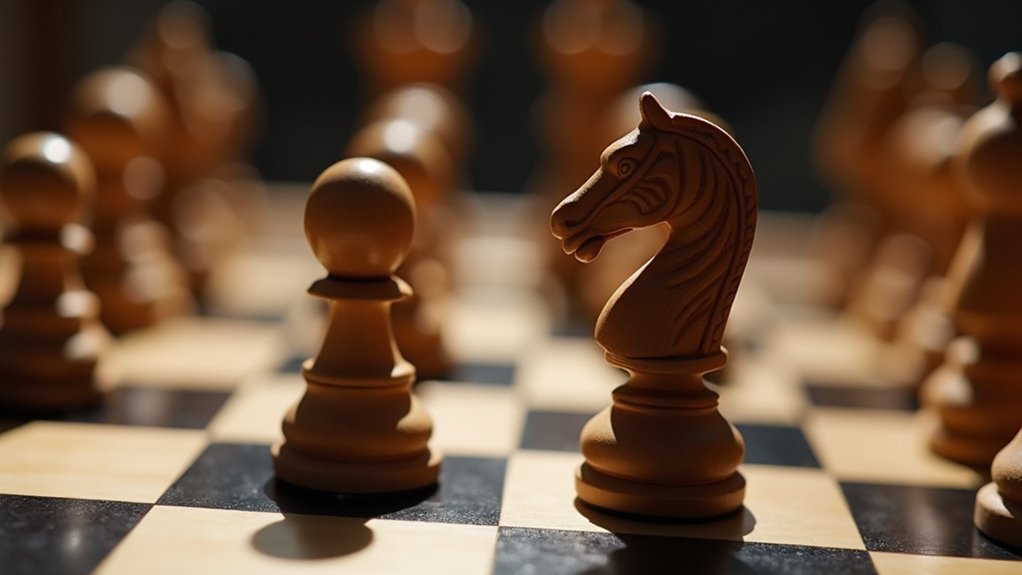
When you want to use your knight effectively, you need to think about its unique movement. The knight moves in an L-shape, allowing it to jump over pieces. This ability can help you control key squares on the board.
For effective positioning, place your knight in the center of the board. This gives it more access to attack and defend.
Use knight tactics to fork your opponent’s pieces, threatening two at once. Look for opportunities to outmaneuver your opponent, as knights excel in closed positions. Additionally, consider establishing a knight on a strong outpost square to maximize its influence and create tactical threats.
Common Traps and Tricks With Knights
While playing chess, you can set traps with your knight to catch your opponent off guard. One effective tactic is using knight forks. A knight fork occurs when your knight attacks two or more pieces at once, forcing your opponent to choose which piece to save.
Another strategy is knight sacrifices. This means you intentionally give up your knight to create a stronger position, often leading to a checkmate or gaining material advantage. Knights are unique in their ability to move in an L-shaped pattern that allows them to jump over other pieces, making them versatile in both offense and defense.
Knights in Endgame Scenarios
In the endgame, knights can become powerful players on the board. Their unique L-shaped movement allows them to control key squares and attack opponents’ pieces.
In knight endgames, positioning is essential; you should aim to control the center and limit your opponent’s mobility.
Additionally, knights can support pawn promotion. When you advance a pawn to the end of the board, it can promote to a queen, rook, bishop, or knight. Understanding theoretical positions can greatly enhance your effectiveness in knight endgames, as it allows you to recognize winning patterns and strategies.
Comparing Knights to Other Chess Pieces
Knights are unique compared to other chess pieces because of their distinctive movement. They move in an L-shape, jumping over other pieces. This makes them versatile in tight spaces where other pieces struggle.
In a knight comparison, you’ll find that bishops and rooks move in straight lines, while pawns advance one square at a time. Queens and kings have their own rules too.
Knights can control more squares in certain positions, giving them strategic advantages. Their ability to hop over pieces allows for unexpected attacks, making them valuable in both offense and defense. Additionally, the rook’s movement along ranks and files is essential to understanding how different pieces interact on the board.
Understanding this helps you appreciate their role on the board.
Famous Games Featuring Knights
Many famous chess games showcase the knight’s unique abilities and strategic importance. One example is the game between Bobby Fischer and Boris Spassky in 1972. Fischer’s legendary knight moves helped him control the board, leading to victory.
Another classic is the game between Garry Kasparov and Anatoly Karpov, where Kasparov’s knight maneuvering created strong threats.
These famous knight games illustrate how knights can jump over pieces, attacking from surprising angles.
FAQs
Can Knights Jump Over Other Pieces on the Board?
Yes, knights can jump over other pieces on the chessboard. This unique knight movement is part of what makes them special in chess strategy.
When you move a knight, it can bypass any piece, whether it’s your own or your opponent’s. This ability allows you to attack or defend without worrying about obstacles.
Use this to your advantage, positioning your knight strategically to control important squares on the board.
How Many Squares Can a Knight Control From Its Position?
A knight can control up to eight squares from its position. This means it can influence these squares, making it a powerful piece on the board.
The knight’s unique movement allows it to jump in an L-shape, reaching different squares that other pieces can’t.
To visualize this, imagine the knight sitting in the center of the board. From there, it can reach all eight squares effectively, creating significant strategic options.
Are Knights Stronger Than Bishops in All Scenarios?
Knights aren’t always stronger than bishops. Each piece has its advantages.
Knights can jump over other pieces, making them useful in crowded positions. They excel in close combat and can control unique squares.
Bishops, however, have strengths in open positions. They can move diagonally across the board, covering long distances. Their ability to control color squares can dominate the game.
To conclude, their effectiveness depends on the position and strategy you’re using.
What Is the Best Way to Develop Knights Early in the Game?
To develop your knights early in the game, focus on ideal knight positioning. Place them on the squares where they control the center, typically c3, f3, c6, and f6. These squares allow knights to influence the game more effectively.
Use early game tactics like developing knights before bishops. Move your pawns to support your knights and create a strong foundation. This strategy helps establish control and prepares for future moves.
How Do Knights Interact With Pawn Structures During Play?
Knights interact with pawn structures by controlling key squares and influencing pawn structure strategies. You can use knights to attack pawns or support your own.
When pawns are on adjacent squares, knights can jump over them, creating threats. Try to place your knights in strong positions where they can control multiple pawns.
This helps you maintain a solid structure while putting pressure on your opponent’s pawns, leading to advantages in your game.
Final Thoughts
To sum up, understanding how knights move in chess is essential for improving your game. Their unique L-shaped path allows them to jump over other pieces, making them versatile. You can use knights effectively in both the opening and endgame. Remember to visualize their moves and look for tactical opportunities. By practicing these strategies, you’ll enhance your skills and become a better player. Keep playing, and you’ll see the power of knights in action!


