
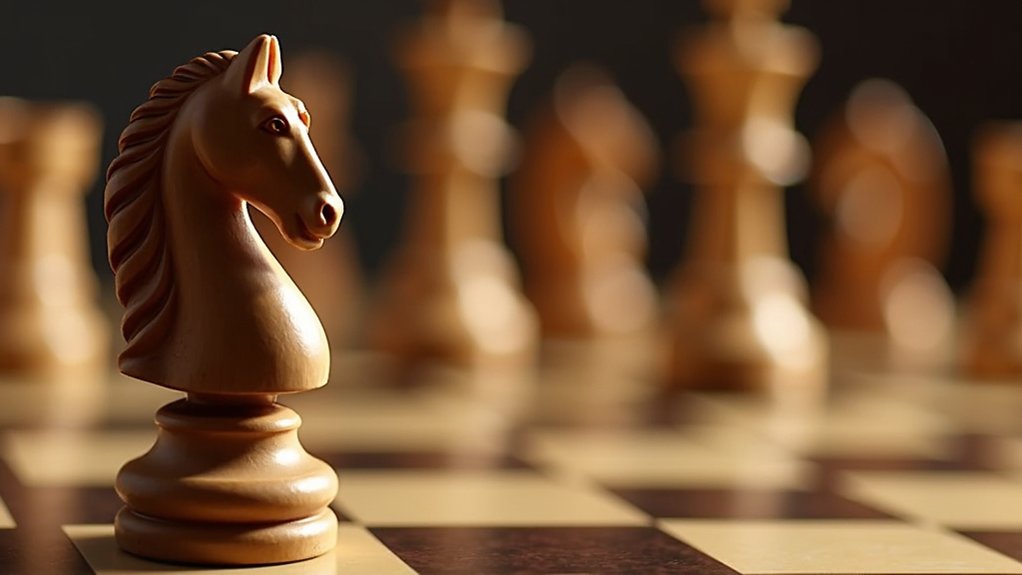
Knights can’t move backwards in chess. Instead, they move in an “L” shape—two squares in one direction, then one square sideways. This unique movement lets knights jump over other pieces. While they can’t retreat, they can threaten multiple enemy pieces at once. Positioning a knight effectively can control the board and support your other pieces. Understanding their movement better helps in using knights strategically. There’s much more to discover about their gameplay and strategies.
Understanding the Knight’s Movement

The knight is one of the most unique pieces in chess because it moves in an L-shape. This means it goes two squares in one direction and then one square perpendicular.
To use your knight effectively, focus on knight positioning. Place it in the center of the board for greater control, as this allows it to utilize its ability to execute forks and attack multiple pieces simultaneously.
The Unique “L”-Shaped Move
Knights move in a unique “L”-shape, which sets them apart from other chess pieces. This movement consists of two squares in one direction and one square perpendicular. Understanding this helps with knight tactics, as you can jump over other pieces, attacking from unexpected angles. Additionally, knights are the only chess pieces that can jump over pieces, which makes them especially valuable for strategic play. Proper piece coordination is essential when using knights effectively. Position your knights to control key squares and support your other pieces.
Can Knights Move Backwards?

When you think about the knight’s unique movement, you might wonder if it can move backwards.
The knight moves in an “L” shape, which consists of two squares in one direction and one square at a right angle.
This means its movement is always forward or sideways, never directly backward. Unlike other pieces, knights can jump over occupied squares, which allows them to navigate around blockages on the board.
Game Scenarios Involving Knights
In chess, different game scenarios can showcase a knight’s unique movement. Knights move in an L-shape, allowing them to jump over other pieces. This ability creates effective knight tactics, like attacking from unexpected angles.
One scenario involves using a knight to fork two pieces, threatening both simultaneously. This can lead to capturing an opponent’s valuable piece.
Another advantage is controlling central squares, enhancing your board position. Effective knight maneuvers can significantly increase your chances of winning the game.
Comparing Knights to Other Pieces

Each chess piece has its own strengths and weaknesses, and comparing knights to other pieces helps you understand their unique role on the board.
Knights move in an L-shape, allowing them to jump over other pieces. This gives them advantages in crowded positions where other pieces may struggle.
In piece comparisons, bishops and rooks move diagonally and straight, respectively, covering more squares but lacking the knight’s ability to leap.
Pawns advance steadily but can’t move backward. Understanding these knight advantages helps you see how they fit into your overall strategy and the best ways to use them alongside other pieces. Additionally, knights excel at creating knight forks that can simultaneously attack multiple pieces, making them a formidable force in tactical play.
Strategies for Using Knights Effectively
To use knights effectively, you should focus on their unique movement and strengths. Knights move in an L-shape, jumping over other pieces. This allows them to access squares that other pieces can’t.
In your knight tactics, aim to control the center of the board. Strong positional play often involves placing knights on strong squares, like outposts, where they can’t be easily attacked.
Always look for forks, where your knight can attack two pieces at once. Additionally, consider how rooks can control open files, as this can complement your knight maneuvers and strengthen your overall position.
Common Misconceptions About Knights
Many players believe knights are weak pieces, but this isn’t true. Knights have unique knight movement, jumping over other pieces and reaching positions that other pieces cannot. This ability can create surprising threats and opportunities.
Some think knights are limited because they can’t move in straight lines. While it’s true that knight limitations mean they can’t control long ranges like rooks or bishops, their short-range power is significant.
Understanding how to use knights effectively can change the game. They can dominate the center, fork enemy pieces, and surprise opponents when used strategically. Their ability to control key squares often provides tactical advantages that can turn the tide of a match.
Historical Context of Knight Movement
The movement of knights in chess has a rich history that reflects the piece’s evolution. Originally, knights represented cavalry in medieval warfare, where their ability to leap over obstacles symbolized their tactical advantage.
As chess developed, so did the knight’s movement. The unique L-shape—two squares in one direction and one square perpendicular—mirrors the unpredictable maneuvers of horsemen in battle.
This historical evolution illustrates how knights shifted from real-life warriors to strategic pieces on the chessboard. Understanding this context helps you appreciate why knights move the way they do today, particularly as chess has maintained its popularity while adapting to different civilizations throughout its 1,500-year journey.
Examples of Knight Moves in Gameplay
When you play chess, understanding how knights move can give you a big advantage. Knights move in an L-shape: two squares in one direction and then one square at a right angle, or vice versa.
This unique movement allows knights to jump over other pieces, making them valuable for controlling the board.
In gameplay examples, you might use knight tactics to fork your opponent’s pieces, threatening two at once.
Another strategy is to place your knight on the center squares, enhancing its reach.
Tips for Beginners on Knight Usage
Understanding how to use knights effectively can elevate your chess game. Start by familiarizing yourself with knight tactics, like controlling the center of the board. Knights move in an “L” shape, so position them where they can jump over other pieces.
Use beginner strategies, such as developing knights early. Place them on active squares to increase their influence.
Avoid moving your knights back and forth unnecessarily, as this wastes valuable moves. Instead, aim for positions where they can attack multiple pieces.
FAQs
Can Knights Capture Pieces When Moving Backwards?
Knights can’t move backwards in chess, but they can capture pieces in any direction they jump. Knight movement is unique; they move in an “L” shape, two squares in one direction and then one square perpendicular. This allows you to surprise your opponent.
When planning your chess strategy, remember that knights can be powerful for capturing pieces. Use their unique movement to your advantage, positioning them for effective attacks.
Are There Any Chess Variants Allowing Knights to Move Differently?
Yes, there are chess variant rules that allow different knight movement variations.
In some variants, knights can move more freely, like jumping over pieces in unique patterns. For example, in “Chaturanga,” knights might’ve enhanced movement options.
Always check the specific rules for each variant, as they can change how knights behave on the board. This adds depth to your strategy and helps you explore new tactics while playing chess.
How Do Knights Interact With Pawns During Gameplay?
Knights interact with pawns in unique ways during gameplay. A knight can jump over pawns, making them useful for attacking or defending.
Understanding pawn positioning strategy is important. When you place pawns, think about how they block or support your knight. A well-placed pawn can protect your knight, while a mispositioned pawn might limit its movement.
Use your knight to control key squares and support your pawn structure effectively for better gameplay.
Do Knights Have Any Special Abilities in Chess?
Knights have unique abilities in chess. They move in an “L” shape, which lets them jump over pieces.
This special movement allows for knight movement strategies like controlling the center of the board or attacking from unexpected angles.
You can use unique knight tactics, such as forking, to threaten multiple pieces at once.
Can Knights Be Blocked by Other Pieces When Moving?
When you move a knight in chess, it can be blocked by other pieces. Knight movement restrictions mean it can jump over pieces, but its destination square must be unoccupied.
If another piece stands in the way of where you want to land, you can’t move there. Use blocking strategies to limit your opponent’s knight movements by placing your pieces strategically, making it harder for them to jump to key squares on the board.
Final Thoughts
In chess, knights can’t move backwards. They move in an “L” shape, which means they jump two squares in one direction and one square perpendicular. This movement allows them to navigate around other pieces easily. Remember, knights can jump over pieces, but they can’t go backwards. Understanding this helps you use knights effectively in your game, making them a powerful tool for attack and defense. Keep practicing their moves to improve your chess skills.


